
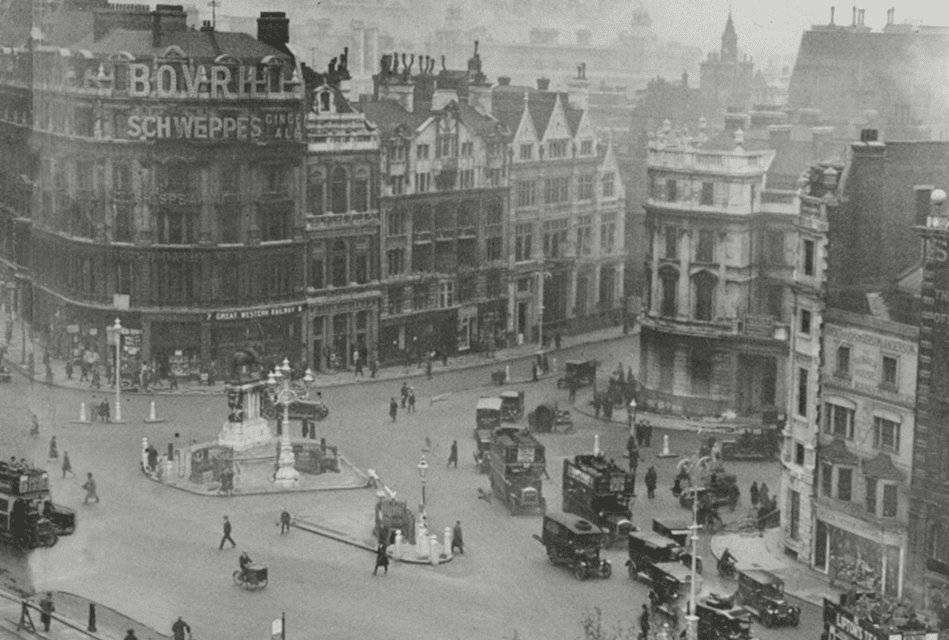
This photograph of Trafalgar Square from April 1926 captures a version of central London that feels both familiar and strangely alien at the same time.
Nelson’s Column still dominates the skyline, the lions still guard the plinth, and St Martin-in-the-Fields still looks serenely down onto the space, yet the square itself is functioning in a completely different way.
In the mid-1920s, Trafalgar Square operated as part of a busy gyratory traffic system. Cars, buses, taxis, delivery carts and horse-drawn vehicles circled the column in a constant mechanical loop, using the square as a working roundabout rather than a place to pause.
Pedestrians were present, but they were secondary to the movement of traffic, negotiating crossings and kerbs rather than lingering, gathering or sitting. It was a transport space first and a civic space second. This layout reflected the priorities of the time – London was modernising rapidly, car ownership was growing, and the city was reorganising itself around traffic flow, efficiency and commerce. After all, public squares were expected to work as infrastructure, not sanctuaries.
Over the decades, that philosophy slowly shifted. By the early 2000s, Trafalgar Square was undergoing one of the most significant urban transformations in its history. The closure of the north side to traffic and the creation of a wide pedestrian terrace rebalanced the space completely. What was once a traffic machine, became a civic living room.
Today, Trafalgar Square is one of the capital’s most important public stages. It hosts national celebrations, vigils, cultural festivals, New Year gatherings, political demonstrations and everyday visitors who come simply to sit, eat lunch, meet friends or watch the world go by. It has become a symbol of London’s openness and its ability to reinvent itself.
Where engines once dominated, people now gather. Where movement was once the priority, meaning has taken over. This single photograph quietly shows how cities evolve, and how public spaces can shift from function to feeling, becoming places that belong not just to transport systems, but to people themselves.